Showing posts with label hogs. Show all posts

Sunday, December 18, 2011

The saga of Trudy's second Bluestem litter

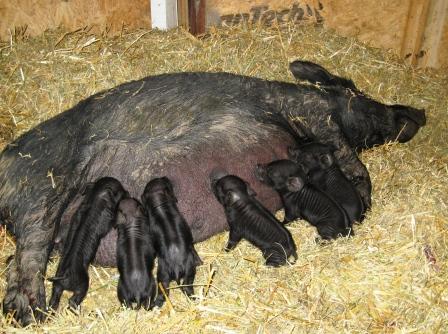
Trudy delivered 9 lovely babies on a chilly Tuesday, November 22.  The smallest was only interested in keeping warm and never tried for a teat so we didn't expect him to make it.  Another pig (#8) had some trouble breathing at first, but pepped up after an hour.  In all I was hoping to see her raise 7 or 8 nice pigs like the last bunch!
But with the Thanksgiving holiday and an over abundance of trust in the process, I did not spend my usual obsessive amount of time with the new family and after a few days things were not progressing as they should have.  Somehow by Friday one pig (a gilt we named "Bertha") was gaining steadily on a productive teat, and the other remaining pigs were still scrabbling over a few minimally productive teats at the milk bar.  They did not seem to have grown much and Trudy seemed to only have substantial milk in a single teat!  I don't know if the babies somehow didn't learn to suck well and the milk dried up, or if the milk dried up first and it hampered their learning to suck... All I can say is that I should have been there.  By the first night each pig should have established ownership over a teat.  Trudy did seem reluctant to stay on her side long enough for even Bertha to drink her fill, so it's possible that her mothering abilities were not kicking in this time, but she seemed in all other ways to be attentive to her brood. 
My folks were visiting for the holiday, so Mom helped with the first few days of, what we hoped would be, supplemental feedings of pig milk replacer.  Our goal was to keep the piglets' strength up while they figured things out with their mom.  Several of the litter had been crushed by Trudy as she laid with them.  The is common with hogs, but not supposed to be a problem with Guinea hogs.  I think they little ones were too weak from not eating enough to get out of the way.  We hoped to save the remaining 5 by giving them their own heated sleeping area away from Trudy.
But as the situation did not improve, we went to plan "raise the pigs in the bathtub."  This was Scott's idea, but he assures me that he was completely joking!  Still when you have to get up every three hours to feed, proximity is key!  Two of the pigs were adept at the bottle from the start, but three were still unproductive after few days.  After reading tips online, I switched everyone over to drinking milk from a dish and that did the trick.  The littlest two had trouble with scours (diarrhea) and needed two rounds of antibiotics to clear them up, but all five are healthy and living in the barn now!  Of the biggest three, Bertha will likely stay here as a breeder, and Wilbur or Nigel will be traveling to a new home in Gardener, KS to grow up to be a herd boar.
Here is Nigel at his first day of preschool at age 2 weeks and 2 days.  He and Wilbur were a hit and "hammed" it up for the crowd.  For photo credit, Katherine took this picture.

At present the 5 piglets: Bertha, Wilbur, Nigel, Annie, and Pip are 3 weeks and 5 days old, spending their days in a protected area outside, and sleeping under their heater in the barn at night.  They've been reunited with their mother and have been getting to know their older siblings.

Thursday, May 26, 2011

Good neighbors

I'm always surprised how well our species interact. 

Here several of the piglets are cleaning up the spilled chicken feed.  This was actually a convinient way for the little ones to access feed withouth their parents fighting them for it. 

Now that the sow and boar are moved out of the barn, the piglets just pop through the gate and sleep with the two pregnant cows in the fresh straw of the stalls.  I feed them there with the cows and the parents get their grain out in the pasture. 

Thursday, May 19, 2011

Pasture management

Mary, her yearling calf, Abe, and Catalina
I let my front paddock become overgrazed last year while we built fences, but it is recovering nicely with the winter and spring rest.  Though this is intended to be my legume-rich pig pasture for the summer, there was so much clover that I had to call in the cows to harvest it.  I held the six of them on this two acre plot for about five days.  Then, cattle were out and pigs again had access to the field. 

Now that all the doctoring is done for a while, I am moving the pigs into their summer cottages and out of the barn stalls where they have slept since moving to Bluestem Farm.  These will be cleaned up and freshened for the next round of babies- calves!

Mary and Martha are both due to deliver in the next few weeks, so they are quarantined in the west paddock to be near the house and barn.  I want the stalls ready in the rare case that they need birth assistance.

I was pretty confident that Mary had weaned Abe a few months back, and that was confirmed when I shut the mother in away from him.  They can still visit through the fence, but there was no bawling at all.  With the impressive store of fat that Mary has accumulated from the spring grass, I was sure that her body was handling the pregnancy well even without artificially weaning her first calf.  

2 pigs, 3 nuts -or- More castration woes

I promised the vet I would try to castrate the final two boar piglets myself (with Scott holding them).  So Monday was the day.  Now of the 5 pigs, one is a girl, and two have castration scars already, but none of that is easy to see when they are on the move.  After a chase, I had both correct boys in the cat carrier.  Scott held the first guy up-side-down by the back legs; I cut and found NOTHING.  Failure again.  We released both pigs and rescheduled with the vet.

Now, other mammal boys keep their testicles in a conveniently accessible pouch, but boars hold theirs up in their body cavities.  Because of that, they can't be banded like bulls, but have to be cut.  Once you have a slit into the body, you still have to palpitate the testicles and manipulate them out of the hole individually. 

At the vet again, we processed each pig in the parking lot shared between the vet office and the local diner.  He made the first pig look so easy, but the second pig- the one I had tried- only yielded ONE testicle!  The side I had cut had nothing to find!  I felt somewhat vindicated that my second failure was not all my own.  Check back with me in six months to see who cuts the next batch of baby boars.

Also, the one pound babies born 7 weeks ago are now close to 20 pounds each according to the scale at the vet.

Saturday, May 14, 2011

Trudy's 2011 litter

I'm pleased to (belatedly) announce that Trudy and Buttercup became the proud parents of seven piglets on April 7, 2011.  Of these, one gilt (girl) and four boars survive, of the home.

The piglet in my lap was the only one born before my early morning check.  I witnessed the other six pop out over the next hour or two.  One runt was weak from the start.  Both he and one brother "disappeared" during their second night under mysterious circumstances...

Castration woes

First time with pigs in my car
I'm getting my stories out of order here, but the boy piglets born April 7 have been in need of castration for a few weeks now.  In the true spirit of book learning, I reread the appropriate passage in Hobby Farms: PIGS, bought scalpels and iodine, and enlisted Scott as pig restrainer.  What the book didn't reveal, is how much fat you need to cut through to reach the desired organs.  I must have put a half inch deep slice in the poor guy (not Scott) before I gave in to his persistent shrieks (also not Scott) and gave up.

At the invitation of our vet, I loaded two of my boar piglets into a large cat carrier and took them to town for professional treatment.  Within a few tense moments, the new barrows (castrated boars), the vet, and I were all bleeding slightly and the job was done.  Now, the rest of the boar piglets are for me to do.  Soon.  If I can get Scott to help.

Follow me, kids...


Our mama pig leads the family out to graze every day.  The little ones are eating clover and the corn/soy mix we have ground at the Baldwin elevator.  Alternating mud baths and sun bathing round out their day.  Occasionally I catch piglets making forays in through the chicken door to clean up the dropped chicken feed, too. 

Weaning at 8 weeks is standard practice with hogs, but I'm tempted to leave them all together for a while longer.  Part of the humane practice of raising animals is to decrease the stress of young weaning and let the generations bond longer.  On the other hand, Trudy won't begin cycling again until after she is weaned from the litter.  With 4 months gestation and 2 months nursing a litter, we can have spring and fall litters at the same time each year.  Longer nursing would mean either a sporadic farrowing (birthing) schedule, or housing the boar separately for much of the year and having one litter.  Most likely, I should wean early, breed Trudy back, and then reunite the family.

Thursday, March 10, 2011

The state of the pasture

Trudy and the calves
So far I can't tell that the hogs have hurt my pasture at all.  I still have them confined in the quarter-acre corral that was vacated by the cows, and though there is little valuable vegetation there, they don't seem to root.  They have worked and re-worked the loose hay, but left the ground alone.

I let the paddocks close to the house get overgrazed last year while we struggled to fix our perimeter fencing.  To repair some of the damage there and to improve my burned pasture, I've been broadcasting red clover seed onto any bare spots.  The legume will add nitrogen and palatability to the grazing in those pastures, especially for my pigs.  I'm hoping some well-managed rotational grazing will fix the rest.

Monday, February 14, 2011

Free at last

Buttercup, the Guinea boar
I shut the cows out of their corral yesterday and turned the hogs outside.  Both buttercup and Trudy enjoyed a little romp in the sun, but came back to their pen in the barn to snooze.  Today is warmer, so I let them out again and fed their grain ration in the clean hay.  This seems to have done the trick for keeping them outside for a while.  They rooted around, ate, and then bedded down in the hay. 
Trudy, the Guinea sow


I moved the hay ring out to the tall grass in another paddock for the cows.  Now that the snow is gone I want to keep them out of the mud they have made in their corral.


As best I know, Trudy will farrow her litter in early April, but if she met Buttercup in early December, it could be as soon as the last week in March.  Either way she'll soon reach her third trimester (last 5 weeks in hogs) and need a little pampering.  Soon I will worm them both (actually, de-worm them) and after 14 days I'll move her to a new farrowing pen.  I'm not really sure where that will be yet, but I have more than two weeks to think about it.  The 14 days gives her time to shed her internal parasites and not carry them to the new area.

Wednesday, February 9, 2011

Buttercup and Trudy again

My sister asked for more photos of the Guinea hogs.  I'm afraid these aren't any better than the last ones, but I hope my hogs will photograph better once they are out on pasture.  They have been patient with their pen in the barn and their rations of alfalfa hay, grain, and stale baked goods, but these guys were made for better things.  When spring comes they will have acres of pasture to explore and consume.  I have high hopes of planting some test plots of field peas, beets, oats, and rapeseed (canola) for hogs to self-harvest.  If these grow well, I can provide nearly 100% of my hog feed right here on Bluestem farm- at least for a season.  Growing my own organic chicken feed is on the project list, too, but probably not for this year.

Monday, January 31, 2011

Introducing: Buttercup and Trudy

This just doesn't give credit to the bulk and strength of these critters.  We might be wise to reinforce the gate to keep them from prying it up. 

I received my first batch of stale bread from the Leo Center food pantry on Sunday.  A local bakery donates bread once a week to the pantry.

Whatever is left when the new bread arrives used to go in the trash, but not any more.  Hogs, chickens, and my wild birds get a chance at it before it goes bad.

When my layers start producing eggs, the Leo Center will be paid back in full for their contribution.  Does anyone else think it may be wrong to feed Challah to pigs?

Farm in a box

My round trip through the Missouri Ozarks to pick up hogs and heifers went smoothly- a great consolation to Scott after my dicey truck-stock trailer-ice-highway incident last winter in Iowa. 

I met Tyke, the hog breeder, in the little Missouri town of El Dorado Springs to transfer the stock from his trailer to mine.  I had visions of stout hogs running wild in the Pamida parking lot, but to my surprise, both boar and sow just stepped daintily from one trailer to the other and settled in for the ride.  The registered Guinea Hog boar, Buttercup, probably earned his name as a two-pound piglet, but at over 200 lbs now, he isn't worried about being teased.  The unnamed sow, I christened Trudy, after a former relation of my husband's. 

Heifers did not load so smoothly.  The farm didn't have adequate loading facilities, so we had to first select the two heifers I wanted and then run the rest of the herd out of the corral.  Then, the two lonely heifers had to be convinced to mount the trailer of their own accord.  After some graceless chasing, one heifer decided to try the trailer.  With little stress, I closed the door and secured her in the front compartment.  The second heifer was in a little panic when she tangeled in a mess of scrap wire that had been left in the corral.  With wire around her neck and legs, she managed to shake free, but by that time she was cut around her mouth and bleeding.  In her terror she started charging at everyone, especially Larry, who retaliated by swinging a board to smack her whenever she got close. 

The only way to treat the heifer was to let her settle herself and find the trailer on her own.  Larry had another idea.  He loaded up an air pistol with bee-bees and started shooting at her from outside the fence.  She didn't understand what he wanted her to do, but she sure knew that he was her enemy.  I was crouching behind the trailer door, in part to swing it shut if she happened to step in, but also to keep from being pinged with bee-bees, as the heifer was now between Larry and me.  When started to load the second clip, I called halt and took my one heifer home.  This wasn't the only sign of poor management that I saw there, but it is by far enough. 

My little yearling, half-belt heifer still calls for her mother some, but the herd has taken her as one of their own.  I think she will continue to gentle up with good management.  I've named her Catalina.

If your grandma is your aunt ...

... you might be a Guinea Hog.  Welcome to the incestuous world of bringing a species back from the brink of extinction.  Never mind that Trudy and Buttercup did come from the Ozarks, line-breeding, the purposefully close breeding for predictable characteristics, is a necessary tool.  The breed had been reduced to only a few animals before efforts to revive it were underway.  There are three separate "lines" of Guinea hogs now.  My breeding stock is firmly in the "Setty" line from Ohio.  The general wisdom among breeders seems to be to maintain these three lines separately through line-breeding and then start crossing them back to each other.  Here are the known pedigrees for Trudy and Buttercup:


Biggers Arthur


DNC George


Celesky's Tulip

BRO Fred


Setty Houdini


DNC Gabby


Celesky's Tulip


Trudy


Biggers Arthur


DNC George


Celesky's Tulip


BRO Homer


Biggers Arthur


DNC Chunky

714 Sky Daisy

Setty Rose


Biggers Arthur


DNC George


BRO Kelsy McGee
Celesky's Tulip


Setty Houdini


DNC Gabby


Celesky's Tulip


Setty Houdini


DNC Buttercup


Setty Rose


I know... It seems a little bizarre.  I'm more a fan of cross-breeding for hybrid vigor, but in this case I understand what the breed association is trying to do.  Still, I could see crossing buttercup with a sow of a different breed now and then for feeder pigs.  It would have to be a small, young sow that he could reach to service.

Thursday, January 13, 2011

Coming soon- Guinea hogs!


Guinea hogs on pasture in SW Missouri
It's been a while since I wrote about hogs, but they've been at the forefront of my farm planning this month.  I mentioned in a previous post that my goal is to raise meat animals that can maximize their use of grass and forage.  My previous three years raising standard breed (Hampshire and Hamp/York cross) feeder pigs has come nowhere close to this goal.  I thought about abandoning hogs for that reason, but we do like the pork and they're a great outlet for garden waste and leftovers.  (We don't have trash pick up here, so nearly every scrap of food waste finds a home in compost or animal feed)
Guinea boar, "Buttercup"

Modern hog breeds need free-choice access to a mixture of grain and soybean oil meal ground to 16% protein.  Organic substitutes are hard to find around here and prohibitively expensive.  The alternative is to raise a heritage breed of hog that was bred to scavenge most of its nutrition.  Guinea hogs were once the most common yard pig in the South where they lived on grass, clover, acorns, food scraps, and their favorite... snakes.  When it fell out of fashion to keep just a few hogs for the family, this breed spiraled toward extinction. 
Guinea sow
 About 20 years ago a small group of breeders, in concert with the American Livestock Breeds Association (ALBA), rounded up all the breeding stock they could find (about 20 animals), to save these unique genetics. 

Guineas are quite a bit smaller than standard hog breeds, with the maximum weight of boars reaching 300 lbs rather than 800 lbs or more.  The pigs are born at just 1 lb and take quite a while to reach their mature size, but since they require so little supplemental feed they shouldn't be overly expensive to raise.

Four-year-old, Buttercup, the boar and the sow at left will be joining us here on Bluestem Farm any day now.  Pigs are expected in April!

Thursday, December 16, 2010

Have you hugged your pig today?

Karen and #36, Hampshire barrow
Me neither.  Our pigs are in the freezer now.  Some day I'll raise fall pigs to take advantage of all the orchard and garden waste that we generate that time of year.  As it is our freezers stay equally full year round as we eat pork, chicken, beef and refill the spaces with stale baked goods, apple peelings, and experimental meals gone awry.  Over the spring and summer the pigs feast on these goodies cooked to boiling along with any milk that gets stepped in by ornery Molly, the milk cow.  My Mom's favorite pig story is from last June when I served my pigs several flats of strawberry tops, a byproduct of jam production, and a batch of cream that refused to turn into butter.


Three Hamp shoats at Bluestem Farm
 I buy feeder pigs as close to home as I can, but in the Spring the competition can be fierce with all the 4-Hers planning to enter the hog shows in August.  I'm happy to take pigs without show-quality markings as long as they are vigorous.  Usually I take several gilts (young girl pigs) because they are less favored for 4-H and tend to yield leaner meat.  The barrows (young ex-boy pigs) that are left to buy tend to be runty, but they are plenty big for most of our customers.  I'm not a fan of the ear notching, but I haven't yet found a farrower (sow/pig farmer) that doesn't do it. 


Karen and three excavators
Vegetation doesn't stand a chance with these guys.  We doubled the size of their pen from what you see here, but they tilled it under in less than a week.  Most people keep pigs on concrete for this reason, or at least put rings in their noses to keep them from rooting.  I prefer to let them do their pig thing.  They tackle the job with such gusto, it would be a shame to take it away from them.  My hope is to find a useful application for all this free tillage, such as preparing ground for grain crops, but that will take more infrastructure than I had last year.