Showing posts with label chickens. Show all posts

Thursday, May 26, 2011

Appartment living, country style

Buff Orpingtons and their cousins, Black Australorps are the usual culprits
Scott built a few more nest boxes for my hens, but the old ones are still the most popular.  Out of my small (less than a dozen) flocks, I've usually tolerated a single broody hen who refuses to leave the nest in the vane hope of hatching eggs. 

This spring I have at least five with the same aspirations.  These ladies are so intent that they never leave the house to forage.  In fact, I think they eat very little at all and their egg production suffers.

When the first of this batch to go broody, a Buff Orpington, started, I took eight eggs and set her on them in an empty rabbit hutch.  The point of separating her is to keep her focused on her job (not really a problem) and to keep other hens from bothering her or adding fresh eggs to her clutch.  After the required 21 days of confinement, she had not hatched a single one.  I gave her a few extra days for good measure, but nothing.

Out of curiosity, I cracked all the eggs open.  Several may have been unfertilized, or had just not gotten started properly, but a few had chicks in various stages of development.  Two where nearly mature.  I don't know exactly what went wrong, but I can think of a few things to change if I try again.  For one, the cage was too big.  She had to leave the nest to reach food and water.  The extra space also allowed her to move the nest around when she turned her eggs, sometimes leaving one or two behind.  For another, we tried this in early spring and the cold snaps may have been too much for the eggs.

Now the question is what to do with the five freeloading hens that are taking up valuable real estate that my layers need...

Tuesday, May 24, 2011

Ouch!

Twin chicken egg and an abandoned bird egg
Someone in our flock keeps laying these monster double-yolk eggs,  this one is the biggest yet.

Sadly, we're getting ready to down-size the flock.  I thought I could find a good venue for selling my surplus eggs, but that's turning out to be more trouble than I want.  Scott and I agreed that a dozen hens would be enough to supply our family, pigs, neighbors, and friends with a few left for the food pantry.  Fewer hens would also allow the grass to recover near the chicken house door. 

Friday, February 25, 2011

Today's catch

Chickens aren't fooled by our latest snowfall.  They know that the days are getting longer.  (It doesn't hurt that we've increased their supplemental light hours, too.)  Until today my record production day from this young flock was 2 eggs.  Today the ladies have started working in earnest with this 11-egg haul.


In addition, I've noticed the ducks "mating" again, so they must be getting ready to lay soon, too.  With our last thaw I've been letting ducks run loose instead of shutting them in their house at night.  They visit the chicken pen for food, bathe in an outdoor pan that I keep filled, and sleep wherever they like (barn, duck house, or under the porch).  They have found ample forage in the yard and pasture.  When they start laying, though, I'll need to reimpose some structure on their ducky lives.  Ducks usually lay in the morning and can be let out to forage after that, but they do not return to their house at dusk as reliably as chickens do.  Perhaps they should be confined with the pigs.  Then, the job of collecting duck eggs can fall to Trudy and Buttercup for their protein and calcium rations.

Monday, February 14, 2011

New chicken house door

The flock has spent the winter "foraging" in the barn which hasn't done much to add to their nutrition, but has been good for moral.  Chickens need entertainment and employment to keep them out of trouble.  Left in confinement, even in a largish chicken pen, they are prone to cannibalism.  Usually the flock will choose the least dominant hen and pull the feathers out of her tail and peck her back until it bleeds.  Once they start this, it's a hard habit to break.  Last winter with the hens house-bound in the old chicken house from the ice and snow, I had to remove a hen for this reason.  She later was able to return when the flock started free-ranging again.  This winter with access to the barn I haven't' had any social problems in the flock (excepting the extra rooster).


Yesterday, Scott cut a hole in the barn to let the chickens access the cattle corral.  This was always the plan, but Scott outdid himself with this design.  The steel door slides up between two vertical channels with a tug on a string that connects through two pulleys to be operable from the barn without going in the pen.  The rest of the structure is a wind- and dog-baffle.  Chickens entering the barn can navigate the narrow hallway between the door and their pen, but dogs and coyotes cannot.  We tested a similar design on the old chicken house and it worked against Koda, the egg-eating dog.  Opossums, raccoons, and cats can still get in this way, but these are less of a problem around here with Holly, the dog, on patrol.  I'll still need to close the flock in at night for their protection and to keep them laying eggs where I can find them.

Sunday, February 13, 2011

First egg

At last!  An egg from my little hens.  By the blue color I know it is from one of my two Americanas.  The white one has become a special favorite of mine.  Scott found the egg, of all places, in the nest box, while putting in a chicken door from the hen pen to the cattle corral. 

Wednesday, February 9, 2011

A good man is hard to find

A good man may be one in a million, but in my experience, a good rooster is about one in four. 

(On a side note... I'm always surprised when people ask me this question, but it has come up often: Don't you need a rooster to get eggs?  The answer, is of course not!  Hens, just like women, "lay" an egg on a regular schedule, whether or not there is an available male of the right species to fertilize it.)

Since I haven't ever raised chicks from my own eggs, it doesn't matter to me if they are fertilized or not.  A good rooster, though, can play a helpful social role in the flock looking after his ladies, keeping the group cohesive, and keeping the peace. 

I didn't actually order a rooster with this batch of hens, but the hatchery included these two for free: a Black Australorp, and an unknown breed.   I preferred the black, since he is of a breed I know well, but the real test was to let the ladies decide.  Wings down, they prefer the black.  When I pick up a hen, he is the first to come running and check out the situation.  More of the ladies forage with him than with the other.  Most importantly, the intimate advances of the black rooster are tolerated, while the best efforts of the mottled rooster result in a great deal of squawking, with the usurper being chased off by the favored male.  So it's not my fault, but spotty rooster will have to go.  It's for his own good, really.  The black male is defending his harem with increasing vigor, and the other, while not a great lover, is certainly no fighter.  This picture doesn't do him justice, he's a big bird and will just fit in the new pressure cooker my Mom gave me.

I actually let him out of the cage since I didn't want to butcher in this cold.  He'll spend a night in solitary sometime soon while I take him off feed for the 12 hours preceding the end.  I've heard this makes chickens more calm at the end, but the real reason is that an empty gut makes them much more sanitary to clean.

Tuesday, January 25, 2011

A very sad story

Katherine and I picked up a store pizza (a splurge for us) to eat at Aunt Vicki's house last night.  On the way home, a quick brake sent our left overs sliding from their confinement and onto the passenger-seat floor... face down. 

There was nothing left to do but treat the flock to Papa Murphy's Gourmet Vegetarian.  By this morning it was all gone.

Saturday, January 8, 2011

Heritage chickens

Katherine and a Delaware hen
The poulty world has its meat bird rock stars and its egg-laying champs, but if you want one breed to do it all, you're in for some compromises.

White cornish hens crossed with white rock roosters produce chicks that achieve 5-6 pound of growth in 6 weeks!  These are what are available in the store, and even from free-range meat producers.  We raise a batch of 50 every fall.  As hybrids they have a few faults: they can't be kept as breeding stock because their chicks will not show the same characteristics, and if kept past 6 weeks, they fall over.  That's right, they eat so much and gain so fast that their little legs just stop holding them up.  People still raise them (even humane and sustainable operations) because they are the only economically feasible option.  Every other breed takes too long to reach maturity.  The costs of housing, care, and feed keep them out of the competition.


For maximum egg production you can't beat the scrawny, nervous leghorn.  For my farm, I want animals that are personable and well-suited to our Kansas climate extremes.  I've always chosen heavy laying chickens because they need only minimal heat in the winter and fill up the pot when their time is up. 

My current flock includes: Buff Orpingtons, Red Star hybrids, Black Australorps, Arucanas, and Delawares.  Of these I'm hoping to have good results from the Delawares.  Of the breeds listed as critical by the ALBC (American Livestock Breeds Conservation), they sound like the best dual-purpose breed for our farm.  If they pass the laying test then they can expect a rooster and chicks in their future.

Delawares were the commercial meat bird of the past before the Cornish cross monster chickens took over.  I can still expect 4 months from hatch to slaughter, but at least I'll have a purpose for the males I hatch.  Up until now I've never encouraged a broody hen to hatch eggs, but that will be in our future I'm sure.  Even so, we'll still probably grow a batch of Cornish crosses for the freezer.

Friday, January 7, 2011

Hen house bedding

Bagged wood chip bedding added to my cost of egg production and needed a season or two of extra composting before it could go on the garden.  Instead, I started using loose straw litter from a neighbor's barn.  All of the good bales are gone, but there is a whole room of the shattered left-overs that is free for the scooping. They're glad to be rid of it, and I'm glad to find straw anywhere this year when no one grew wheat.  Did I mention it's free?

This year I also scored two truck-loads of city leaves (Thank you, Glenna!).  I put the first load directly on the garden, but then later found that they work pretty well as bedding for chickens and cows when mixed with the straw.  Next fall I'll be out trolling the neighborhoods for more bagged leaves.

The irony is that my suburban parents spend all fall, winter, and spring bagging leaves, but they live too far away to work out a trade.

Getting ready for eggs

 Now that my new flock of chickens was nearing 4 months old, it was time to move the nest boxes from the old chicken house to their new pen.  Katherine helped me plant the fake, wooden eggs in the boxes to get the hens thinking about adding to the collection.  This has worked surprisingly well on past flocks, even though we were too cheep to buy real wooden eggs.  Round wooden balls are cheaper, and since none of these hens has ever seen an egg they don't seem to know the difference.
Three nest boxes was usually enough for my small flock, but with 25 hens this time, I need to make a few more.  If an expectant hen finds no room in the inn, she'll lay eggs on the floor- a hard habit to break.  I should still have a few weeks before my first egg, though.

Tuesday, December 28, 2010

The best little chicken house, and why we abandonded it (Part 2)

New chicken pen in barn
I know I left you all hanging with the last story about the pretty little chicken house in the yard.  So perfect in many ways, it encouraged the flock to focus their messy free-ranging in our yard.  When I suggested to Scott that maybe the chickens could be confined to the cattle pens and pastures, he jumped at the idea and built our new, larger flock a home of their own in the ag barn.  With a little extra chicken-proofing of our field fence, I'll be able to plant berry plants in the yard without a fence! 

Chicken roosts
The new pen has many of the features of the old coop with additional floor space for our 25 pullets (young hens) and one cockerel (young rooster).  The elevated roosts have removable poo-collection boards that help keep the litter clean longer.  When it's time to change the litter (straw and chopped leaves) I mix the manure back in and put it outside to weather down for a perfect compost.

Feeders and waterers go under the boards to discourage chickens from roosting on them.  In the summer I plan to build a chicken nipple waterer.  For now my fountain waterer is in winter mode with a heating pad under it on low to keep it just above freezing. 

Chickens exploring outside
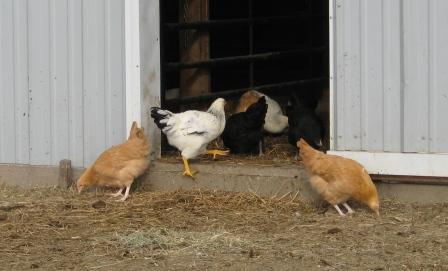
Chickens will soon have a window and an outside door of their own, but in the mean time they have access to the interior of the barn and like to rummage for dropped grain in the cow stalls.  They are slowly braving the outdoors.

These chickens will play a critical role in controlling cattle parasites- a key element in organic production.  No worries about making chickens sick; species that do not share parasites can safely run together or in a leader-follower system (more on that later).

Tuesday, December 21, 2010

Happy solstice morning

View to the southeast, Bluestem Farm
 According to Uncle Bill's calculations we should have 9 hours and 26 minutes of daylight today at the latitude of our farm.  Each day will get longer until, in a few months, Scott will again be able to detach from the wood stove.  

Our young flock of laying hens (pullets) need increasing day lengths to mature and start laying.  Rather than wait on the sun, I've been fooling them with a little extra light.  I hope to start seeing eggs in January and then I can wean them back to natural light.

Tuesday, December 14, 2010

The best little chicken house, and why we abandoned it (part 1)

Chicken house at Bluestem Farm
Here at 38.8º N latitude (let’s say 40º) the noon sun angle is:

27.5º    on the Winter Solstice
50º       on the Equinoxes
73.5º    on the Summer Solstice

The overhang on this south-facing chicken house allows winter sun into the windows, while shading out the summer sun.  Plexiglas panes snap tightly over the hardware cloth window screening for the coldest days of the year or are angled open for ventilation.  With this treatment the daytime temperatures stay pleasant (50s on sunny, cold days) and rarely dip much below freezing on even the coldest nights. 

With three elevated nest boxes, roost bars with dropping pans to keep the floor bedding clean, and little bins for oyster shell and grit, WHY did we abandon it?

Let me say, the fault does not lie with the house design- if I were to build a stand alone chicken house again, this would be the one- but with my underestimation of the excavation talents of chickens.  

Foraging Buff Orpington
What's the fun of having chickens if they can't free-range for their own entertainment and ours?  What they save on the feed bill, though, was eating into my mulch bill, as they rearranged every scrap of biomass in our large yard.  The orchard trees were surely safe from soil-born insects, but their roots were exposed to the drying summer sun and winter winds.  I finally gave up planting anything decorative, as my two-footed friends would dig up or devour any new additions, scattering mulch and over the driveway.  Flower pots on the porch were emptied down to squatting-chicken-eye-level, and the dogs kept a nose out for eggs deposited there.  My veggie garden needed a four-foot fence.

Foraging Buff Orpington
For four years our house guests were greeted with a poo-strewn path to the front door, but surprisingly none of this bothered me too much.  It was Scott that finally snapped when he'd find a whole flock of chickens and the two ducks hanging out in the garage along with all the accompanying floor blobs.  A few slimy slips getting into the car and Scott was ready for a change. 

Why not let the chickens range with the cattle where they can help rid the paddocks of flies and pests for the comfort and health of the herd?


Monday, December 13, 2010

Us and Them

Store-bought- and Bluestem Farm winter eggs
Even in the heart of winter when chicken foraging is at a minimum, our eggs  (right) beat the pants off of store eggs (left).  We gave the rest of these away when our girls finished their molt and started laying again. 

7 times more beta carotene
3 times more vitamin E
2 times more omega 3
2/3 more vitamin A

1/3 less cholesterol
1/4 less saturated fat

(stats from Mother Earth News)