Showing posts with label habitat. Show all posts

Wednesday, March 14, 2012

Oops!

I'm not always good about sharing my mistakes, but this one was pretty public in my neighborhood so here you have it! 

In February, I was so excited from talking to a woman at a grazing conference about patch burning, I thought, "I know it's been a little dry (deep drought) but I'll just try this one little match..."


 30 acres and a visit from my friendly neighborhood fire department later...


... and no more grass.

It probably serves me right since I've been getting cocky about my spring burning.  In the end, with the diligent intervention of our (free) township fire department, nothing burned but grass.  It could have been much, much worse with several neighborhood houses and barns in the path.  Thanks guys!

Saturday, August 13, 2011

Pasture in the drought

Our native grass pasture, 8/2/2011

Our neighbor's non-native pasture, 8/2/2011

I've been so pleased with the way our grass has weathered the last month of high temperatures.  That's no real credit to us; the native grasses grow deep roots and are "warm-season" growers.  Most of the grazing land in eastern Kansas and surroundings is managed for "cool-season" grasses that can out-perform my natives in the early spring.

Monday, June 27, 2011

Thursday, March 10, 2011

My favorite day of the year

Scott will tell you that I anticipate the spring burn more than most holidays.  You could say that it's because it starts the growing season at Bluestem Farm, but the real reason is the chance to play with FIRE.

Years ago we would load up the truck with a full 250 gallon water tank as well as various buckets and sprayers.  Later we upgraded to the 10 gallon spray tank with electric pump that could project water further from the truck bed.  Soon after, we ditched the truck all together and carried 3 gallon spray tanks that we could refill from the pond. 

This year with a rare east wind that could only carry the fire back toward bare, tilled fields, I set off with a box of matches, holly, the dog, and not a drop of water.  I later walked the fence with a spray tank to see if any posts were smoldering, but I didn't find any so I just dumped the water out.

Maybe I'm getting cocky, but I think I'm getting better at anticipating what the fire will do.  I picked a day with a steady wind to give the fire direction, and soggy ground to keep the blaze contained within my mowed paths.  Where the flames wanted to creep too far in the wrong direction, I just stamped them out with my wet boots. 

I only burned half of my pasture this time.  I'll probably burn the rest later in the spring.  The goal is to increase plant diversity with the two different burn times, and to have a little less adverse affect on wildlife using the pasture for cover.  The burn is so fast and "cool" that Holly barely waits for the flames to pass before she's out digging for field mice.  The coyotes will show up soon too for the feast.

My neighbor to the south was burning at the same time.  Usually, I burn first and try not to burn through to his pasture, but this time he was just beyond the tree line from the area I planned NOT to burn!  No problem.  What little undergrowth the trees don't shade out, greens up fast in the spring and will rarely carry the burn through.

Thursday, January 20, 2011

What to do with the back 40

Bluestem Farm back 40
I mentioned in a previous post that we lease our back 40 to neighbors for conventional farming.  I've never been excited about the chemicals and bare ground, but we haven't yet decided what else to do there.  Besides, it currently provides the "seed" money for Katherine's college fund!  Check out the aerial view of our farm at this LINK.


In the running are a few (expensive) ideas.


1.  I've always dreamed of a prairie restoration here.  The cost of seed, and rented equipment to get it started is significant, not to mention the lost income.  The prairie could be grazed as part of my beef operation, but that would mean replacing 4,000 feet of decrepit, overgrown fence.  I'm looking into grants or assistance for this sort of work.  A partnership with KU or the Kansas Biological Survey might make for a good options, too.

2.  Scott's dream is to convert the land to organic grain production.  It takes seven years chemical-free to certify crop ground as organic.  (We're not likely to pay for the certification, but we'd still follow this guideline.)  Our lawn tractor is severely under-sized for a job like this, not to mention the many farm implements that it would take to plant, harvest, clean seed, and mill into flour.  That said, I think Scott's right about a market for local, organic flour.
Strip Cropping Photo credit

3.  Possibly the wisest use of the crop land would be some kind of strip cropping polyculture.  Grazing crops like grass and alfalfa could be grown in a mosaic with fruit and nut trees, grains, and veggies.  This too requires quite an investment, but may offer the best long-range return while still providing a diverse habitat for native wildlife.

Clearly I have some reading to do.  The neighbors have already fertilized and tilled the ground for next year's crop, so any major decisions will wait a year or two.  In the mean time, I think I'll beg back an acre for some experimental wheat and oat crops.  This will let us get our feet wet without disrupting our income.

Monday, January 10, 2011

First snow at Bluestem Farm

Agnes, Mary, and Abe back in the corral at Bluestem Farm
The herd celebrated the first snow of the winter with a nocturnal jaunt through the yard.

With Molly and Jake locked in the barn for forced family therapy, I'm making regular trips to the round bale to pull off their hand- delivered rations.  More than once when I have pulled the gate shut, it hasn't latched, but last night is the first time anyone has gotten out.  I think the north wind blew the gate open and invited them to explore.
Young oak tree in our back yard


Scott noticed the tracks before sun-up this morning and followed them all around the yard by flashlight.  When he traced them back to the herd, they were contentedly munching hay at the feeder, having determined that there is indeed, NO grass on the other side.  Had there been grass showing, they may have lingered, but with a thick coat of snow, the yard was no more interesting than their own pastures. 

The birds are active and more visible with the snow.  They've found my suet feeder in the oak tree, and something of interest in the compost pile.

I'm truly grateful for all the dry, 50 degree days we've had this winter, but now with a little snow, I can finally stop watering my fruit trees!

Male cardinal sheltering in the oak

Tuesday, December 28, 2010

In defence of omnivory

A key concept reoccurring in my environmental studies degree at KU was the 10% rule.  For every step in a food chain (such as from grain to mice to hawks) only 10% of the energy required to grow the prey is passed to the predator.  In other words, the top predators in a food chain are the least efficient at using the energy that comes ultimately from the sun.  A logical extension of this concept is that feeding people on plants is more efficient than feeding plants to animals and eating the animals.  Think of the additional people that could be fed on existing world food supplies by cutting animals out of the plan.

Bluestem Farm organic pasture
Bluestem Farm conventional crop land leased to neighbors
I struggled with this as an young omnivore until I realized people foods (mainly grain) do not need to be fed to livestock.  If animals can make use of food sources that are unusable to humans (grass, weeds, bugs, etc.) then they can provide people with a high quality diet without subtracting from calories available elsewhere. That's why our goal at Bluestem Farm is to grow all our livestock on grass.  We're not there yet.  Some animals are an easy fit; cows, sheep, and goats are all ruminants that thrive on grass.  Others require an omnivorous diet; chickens and pigs have simple stomachs and need more protein in their diets than grass can provide.  One possible solution is to feed grass-fed cow or goat milk to chickens and pigs. 

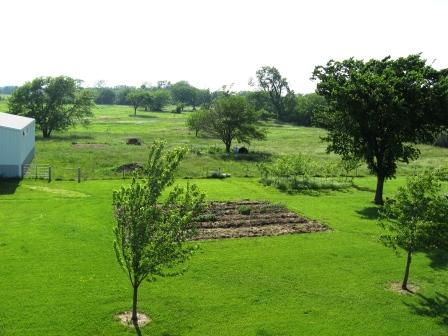
The moral justification of eating meat can be summed up for me by these two views of our farm in winter.  The first is the habitat created by grass-fed beef production.  This land supports bugs, birds, snakes, rodents, deer, coyotes, and a host of soil-dwelling microbes.  The second is the habitat created by soybean monoculture.  It is devoid of life in winter, offering neither food nor shelter to wildlife.

Tuesday, December 21, 2010

Happy solstice morning

View to the southeast, Bluestem Farm
 According to Uncle Bill's calculations we should have 9 hours and 26 minutes of daylight today at the latitude of our farm.  Each day will get longer until, in a few months, Scott will again be able to detach from the wood stove.  

Our young flock of laying hens (pullets) need increasing day lengths to mature and start laying.  Rather than wait on the sun, I've been fooling them with a little extra light.  I hope to start seeing eggs in January and then I can wean them back to natural light.

Sunday, December 19, 2010

A good day to tie one on

 Or in this case a case a couple hundred (fence ties, that is.)  Forty degree days in December are a blessing not to be wasted.  I'd been wanting this west paddock finished before spring and with a willing Scott, we got it done today.  Below is Scott's handy field-fence un-roller.  This is just one of the many inventions, small and large, that help make him a FARM GENIUS.  
Scott and the fence un-roller
Building the west paddock
I now have a corral on the south side of the barn, and three paddocks 2-3 acres each.  The rest of the pasture is open.  This isn't enough for a true rotational grazing set up, but it does start to give me some control over my stocking rates.  I need to keep the cows close to home during calving and breeding seasons.  Last year, I repeatedly abused my one paddock by overgrazing it.


If it doesn't grow back well enough in the spring, it may need to be reseeded- not the way to run a sustainable operation!  Now with three paddocks I can rest each of them to maintain good grass growth and diversity.  The other 20 acres of pasture will be an open salad bar until I can get some cross-fencing there too. 


Katherine climbing a locust tree in the west paddock
Katherine helped build fence by playing contentedly in our new 3 acre playpen while we worked.  What more could a kid want than trees to climb, dirt to dig, and by the end of the day- snowflakes to catch.

Sunday, December 12, 2010

It all starts here

Big Bluestem (Andropogon gerardii)
Four years of annual spring burning reawakened the native grass seeds under our brome/fescue pasture for a beautiful, thick stand of big bluestem (our farm's namesake), little bluestem, indiangrass, and panicgrass.  The wildflowers and herbs that should have accompanied a native prairie, though, were only abundant in the areas I had also mowed.  Plant diversity, it seemed, needed more management than fire alone.  After a conversation with KU professor and author, Kelly Kindscher, I realized that prairies had evolved to be clipped, mowed, grazed.

After giving our pasture a four-year rest, we were ready to bring back the grazers...


Agnes, the Angus, Karen, and Zeke the cat

...Enter Agnes (the Angus) the first of our herd of seven bovine.  (Only 2 of which are "cows" or females that have borne a calf.)  With the use of management-intinsive grazing, called MiG in the graziers' lingo, these ladies and their babies will produce healthy, grass-fed beef while increasing the plant and animal diversity on our farm.